
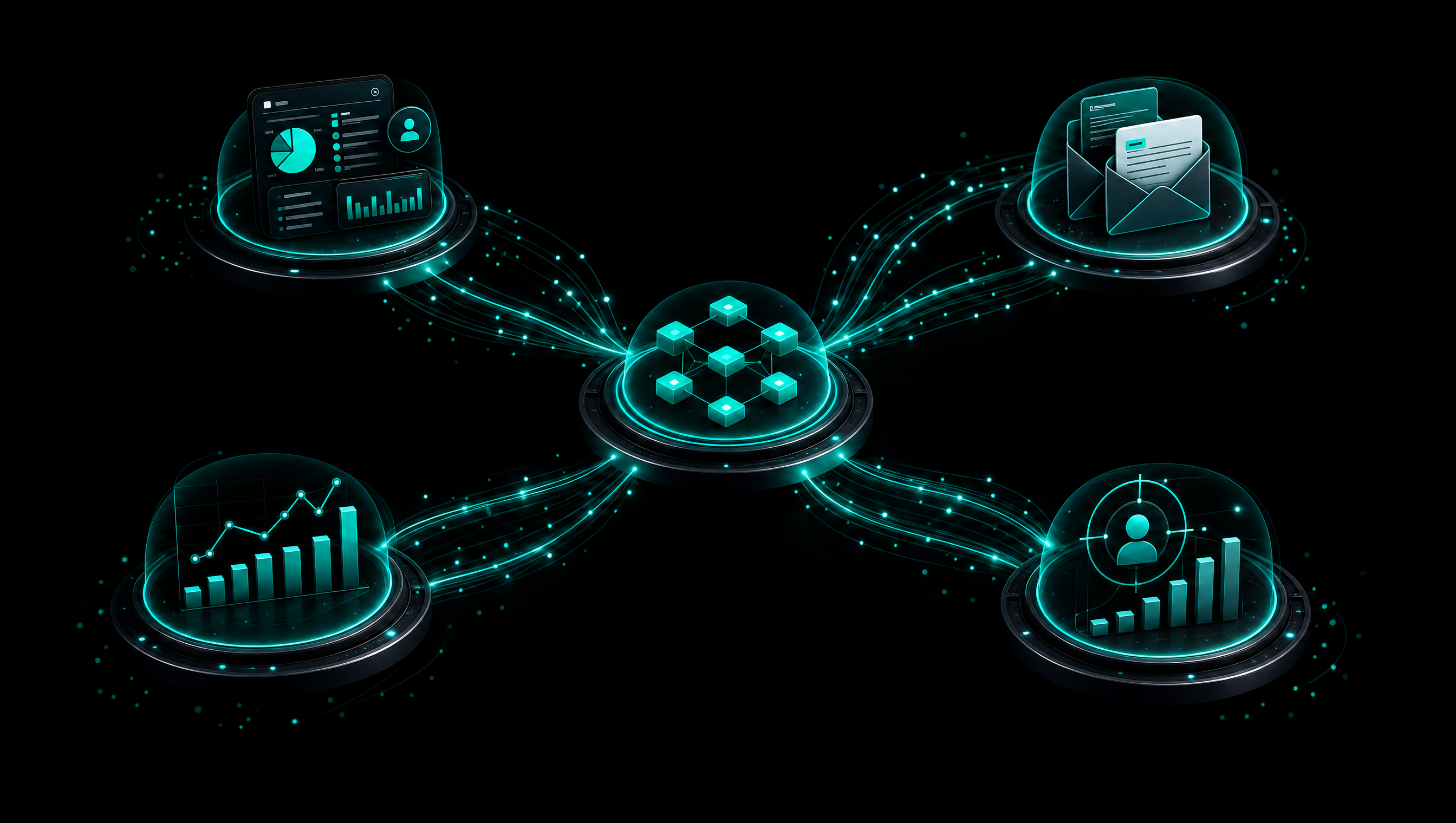
Every software company with a product built after 2023 now uses the word "agent." Every vendor pitch deck has a slide with the word "agentic." Every marketing conference has a keynote about AI agents transforming business operations.
And yet, according to enterprise deployment data published in early 2026, 88% of AI agent projects never reach production. Of the companies that claim to be running AI agents, only 1 in 9 has anything genuinely autonomous in operation.
The gap between the language and the reality is significant. This article closes it.
Here is what agentic AI actually is, what it does specifically in marketing, where the real results are coming from, and what is genuinely holding most businesses back.
The Distinction That Actually Matters: Agent vs. Chatbot
The confusion starts with language. Both chatbots and AI agents use large language models. Both can generate text. The similarity ends there.
A chatbot is reactive. It waits for a user to ask something, generates a response, and stops. It has no memory of what happened before the conversation started. It cannot take actions in external systems. It cannot decide what to do next on its own.
An AI agent is autonomous. Given a goal, it plans a sequence of steps, calls external tools (a CRM, an ad platform, an email system, a database), executes those steps, evaluates whether the outcome matched the goal, and adapts its approach. A human does not need to trigger each step. The agent runs until the task is complete, or until it encounters something it cannot resolve and flags a human.
The architecture is the difference. Chatbots have a language model and an output. Agents have a language model plus an action layer, plus memory, plus a planning loop.
Here is the clearest practical example. A chatbot answers the question "what are our open leads?" An AI agent, given the goal of re-engaging stale leads, does this: monitors your CRM, identifies leads dormant for 14 days, drafts personalized follow-up messages for each, sends them at the optimal time, logs the activity in the CRM, scores responses, and flags the ones showing high intent for your sales team, all without being asked. That is the difference.
Gartner estimates that only around 130 of the thousands of vendors currently calling their products "AI agents" are delivering genuinely agentic architecture. The rest is rebranding.
Where Agentic AI Actually Is in 2026
Adoption has accelerated sharply. In mid-2024, 33% of organizations had at least one AI agent in any stage of deployment. By early 2026, that figure reached 54%, with 31% reporting at least one agent running in full production.
The market reflects this: the global AI agents sector was valued at $7.6 billion in 2025 and is projected to reach $47.1 billion by 2030, a 45.8% compound annual growth rate.
But here is the number that matters more than any of the above: 88% of AI agent projects never make it to production. The majority of "AI agent strategies" are either still in pilot, stalled by integration problems, or quietly cancelled after failing to demonstrate ROI.
The companies succeeding are not the ones who deployed the most agents. They are the ones who redesigned their workflows before deploying any agent. Organizations that report significant ROI from agentic AI are twice as likely to have restructured end-to-end processes before the deployment began.
What AI Agents Are Actually Doing in Marketing
The marketing function has seen the most concrete agentic deployments outside of customer service. Here is where agents are operating right now.
Lead Scoring and Qualification
Traditional lead scoring assigns static points to demographic attributes. AI agents score dynamically, evaluating hundreds of behavioral signals in real time: website activity, content engagement patterns, email open sequences, tech stack changes at the company, and intent signals from third-party data sources. When a prospect's score crosses a threshold, the agent triggers the next action automatically. Companies with clean CRM data have seen up to 60% improvement in lead scoring accuracy compared to rule-based systems.
Email and Outreach Sequences
AI agents determine optimal send times per contact, write personalized subject lines and body copy based on the contact's behavior and industry, trigger follow-ups when emails are opened but not replied to, and pause sequences when a prospect books a call, all without a human scheduling or approving each step. The 167% increase in qualified leads reported by companies using AI-powered email outreach is contingent on one prerequisite: clean, structured CRM data. The agent is only as good as what it has to work with.
Social Media and Content
Content agents monitor performance data across platforms, identify which formats and topics are generating engagement, generate content variations aligned to brand voice, schedule posts at optimal times, and reallocate effort toward what is working. These are not content generators in the traditional sense. They are content operations systems that adapt continuously rather than requiring a human decision at each step.
Ad Management
Ad agents scan performance data continuously, adjust bids in real time, pause underperforming creatives before spend accumulates, and reallocate budget toward top performers. For businesses running campaigns across multiple platforms simultaneously, this removes the latency problem: human-managed campaigns are optimized weekly at best. Agent-managed campaigns are optimized hourly.
CRM Hygiene
Perhaps the least glamorous and most valuable use case. CRM agents update contact records when new data surfaces, log all communication activity automatically, flag deals that have gone stale, surface next-best-action recommendations, and identify duplicate records before they corrupt reporting. Clean CRM data is the prerequisite for every other marketing agent to work. Most businesses do not have it. This is where many successful deployments begin.
The Results: What the Numbers Actually Show
The performance data on agentic marketing deployments spans a wide range, because outcomes depend almost entirely on data quality and workflow design. Here is what the cases with clean conditions show.
Verizon deployed an AI sales assistant across its sales organization in partnership with Google. The result was a 40% increase in sales. The agent handled lead qualification, surfaced next-best actions for each prospect, and personalized outreach at a scale no human team could match.
Grubhub used agentic workflows for targeted marketing campaigns. The result: 836% ROI increase, 20% more orders overall, and a 188% rise in Grubhub+ Student signups. The agent managed audience segmentation, campaign personalization, and performance optimization simultaneously, replacing what had been a heavily manual campaign management process.
ServiceNow deployed agents in customer operations rather than marketing directly, but the operational lesson applies: 52% reduction in time to resolve complex cases. That freed human capacity for work that required judgment. The same logic applies when AI agents handle marketing operations: your team stops managing workflow and starts making decisions.
Across the broader market, companies reporting successful agentic deployments show revenue uplifts of 3 to 15%, lead quality improvements of 50 to 80%, and conversion rate increases of 30 to 40%. These numbers require honest qualification: they represent the upper tier of deployments, not the average. The average includes the 88% that did not make it to production.
What Is Actually Holding Businesses Back
The failure reasons are consistent across the research. They are not technical. The models work. The platforms exist. What fails is everything around the deployment.
Data quality. 43% of AI leaders cite data quality and readiness as their primary obstacle. An agent running on incomplete, inconsistent, or duplicate data does not produce mediocre results. It produces confidently wrong results at scale, fast. One data quality issue becomes ten thousand errors before anyone notices.
Compounding error. An agent with 85% accuracy per action, running a 10-step workflow, succeeds approximately 20% of the time on the full task. This is basic probability. Most vendors do not explain it. More steps means exponentially more failure. The implication is that agents should start with short, high-confidence workflows, not end-to-end automation from day one.
Integration friction. 95% of IT leaders report significant integration hurdles when deploying AI agents. Marketing stacks were not built for agents. CRMs, ad platforms, email tools, and analytics systems were built for humans. Connecting them for autonomous agent operation requires engineering work that most vendors underestimate in their sales process.
Workflow inertia. The most common deployment failure: dropping an agent into an existing broken process and expecting improvement. Agents amplify the workflow they run in. A poorly designed lead qualification process with an AI agent becomes a faster, more consistent version of the same broken process. Redesigning the workflow before deployment is the work that determines whether the agent succeeds.
Governance absence. Over 40% of agentic AI projects face cancellation risk by 2027, according to current projections, specifically because organizations deployed without clear accountability for agent decisions. When an agent makes an error (and it will), the question of who owns the outcome needs to be answered before the agent runs, not after.
What Changed Between 2024 and 2026
Two years ago, AI agents were narrow and fragile. A single agent handled one task, had no memory of prior sessions, and required a human at nearly every decision point. They were more sophisticated automations than genuinely autonomous systems.
The architecture has shifted. Multi-agent systems are now the standard approach for complex deployments. A lead generation system today might run a research agent, a scoring agent, a personalization agent, and an outreach agent in parallel, each specialized, all coordinating. Context windows are 10 to 100 times larger than 2024 models. Agents now maintain persistent memory across sessions, meaning they learn the preferences and patterns of each contact over time rather than starting fresh every interaction.
The critical operational shift: agents no longer require human approval at each step. They run, flag exceptions, and surface only the decisions that require human judgment. Gartner projects that by 2028, at least 15% of business decisions will be made autonomously by AI agents, up from near zero in 2024.
The market went from curious to building. Gartner recorded a 1,445% surge in enterprise inquiries about multi-agent systems between the first quarter of 2024 and the second quarter of 2025.
The Honest Assessment
Agentic AI in marketing is real. The results are real. The failure rate is also real, and it is high.
The businesses winning with AI agents right now share three characteristics: they started with clean data, they redesigned workflows before adding automation, and they deployed narrow agents on short tasks before building toward end-to-end systems.
The businesses failing are deploying agents as a signal rather than as infrastructure. The agent is there to say "we are doing AI." The data underneath it is inconsistent. The workflow it runs in was designed for a human. And when results do not materialize, the conclusion is that AI does not work, when the actual conclusion should be that the foundation was not ready.
The question for any business evaluating agentic AI for marketing is not "which agent should we deploy?" It is "what does our data infrastructure look like, and which workflow would an agent make meaningfully better right now?"
Those two questions, answered honestly, separate the 12% who are getting results from the 88% who are not.
Where Ensign Fits
Ensign builds the infrastructure that makes agentic marketing work: the CRM architecture, the data pipelines, the automation workflows, and the agent layer that runs on top of them. We do not deploy agents into broken systems. We build the systems first, then add the agents.
If you are evaluating whether your business is ready to deploy AI agents in marketing, start with our AI solutions overview or book a call. The assessment is free. The clarity is immediate.
Frequently Asked Questions
What is the difference between an AI agent and a chatbot?
A chatbot is reactive: it waits for a question and generates an answer. An AI agent is autonomous: given a goal, it plans a sequence of steps, calls external tools (CRM, ad platforms, email systems), executes tasks, evaluates results, and adapts, all without a human triggering each action. The key difference is the action layer and the planning loop.
Are AI agents actually being used in marketing today?
Yes, but adoption is uneven. 54% of organizations report actively deploying AI agents across core operations. However, 88% of AI agent projects never reach production. Companies successfully using agents in marketing include Verizon (40% sales increase), Grubhub (836% ROI increase), and ServiceNow (52% reduction in case resolution time).
What marketing tasks can AI agents handle?
AI agents are currently handling lead scoring, email personalization and follow-up sequences, CRM hygiene and record updates, social content scheduling, ad bid management and budget reallocation, and customer service case routing. The most effective deployments combine multiple agents working together, each handling a specific part of the marketing funnel.
Why do most AI agent deployments fail?
The primary reasons are data quality issues (43% of AI leaders cite this as their top obstacle), integration friction with existing marketing stacks (95% of IT leaders report integration hurdles), and deploying agents into poorly designed workflows. An agent running 10 steps at 85% accuracy succeeds only 20% of the time due to compounding error, which is why clean data and simple workflows are prerequisites.
How is agentic AI different in 2026 compared to 2024?
In 2024, agents were narrow and single-task. They had no memory between sessions and required human checkpoints at each step. In 2026, multi-agent architectures allow specialized agents to collaborate, delegate to sub-agents, and maintain persistent memory across sessions. Context windows are 10 to 100 times larger. Agents now flag exceptions rather than requiring approval at every step.